
Kilmallock
Kilmallock carries a green and yellow United identity, rooted in the historic County Limerick town and visible across junior and youth football.
Name and identity
Kilmallock is the short football name used for this club entry, while the fuller name Kilmallock United AFC is also used in football and club kit settings. Families and visiting teams may see either form.
The United name matters because it connects the youth entry with a wider football story in the town. Kilmallock has a recognisable senior and underage footprint, with cup milestones that reach beyond ordinary local league weekends.
Crest and colours
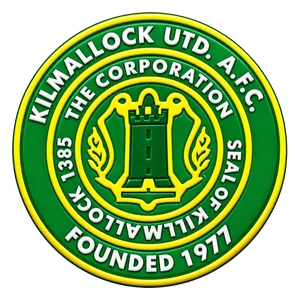
The badge uses a green circle, yellow ring lines, white lettering and a central tower seal. The words Kilmallock Utd. A.F.C., The Corporation, Seal of Kilmallock and Founded 1977 are all part of the visible identity.
Green and yellow are the strongest badge colours, while teamwear also uses black and white. That colour set gives the club a clear football look and a strong connection with the heritage mark in the middle of the crest.
Kilmallock town setting
Kilmallock is one of south Limerick’s best known historic towns. The football identity sits beside that town setting, with the tower and seal imagery on the badge giving the club a local marker that is easy to recognise.
For match travel, the safest starting point is Kilmallock town until the organiser confirms the exact pitch. The town centre map below is a navigation anchor, not a fixed home ground claim.
Visitor anchor: Kilmallock, County Limerick. Confirm the named venue before travelling.
Limerick junior football
Kilmallock United AFC is part of the Limerick junior football picture. The club name is active in national junior cup draws and local league conversation, which keeps the town connected with adult competition as well as youth football.
That adult presence helps younger players. A visible senior pathway gives teenagers a football roof above them and shows that the club name can still matter after schoolboy age groups.
Current linked teams
The current connected teams include Kilmallock United boys teams at U11, U12, U13 and U16, plus girls teams at U12 and U13. The boys pathway also separates B squads at U12 and U13 level.
That spread gives the club a stronger underage picture than the original bare club listing suggested. Families can see boys and girls football in the same club identity, with several teenage and preteen squads connected to the Kilmallock name.
National cup standard
Kilmallock United were in the last eight of the FAI Junior Cup in 2017. Reaching that stage is a strong marker for any community club because the competition draws clubs from across the country.
The club name has also remained visible in later national junior cup draws. For players, that creates a simple message: local football in Kilmallock can still lead into wider Irish junior football settings.
Munster Junior Cup marker
Kilmallock were Munster Junior Cup finalists in the 1986 to 1987 season. That final place gives the club an older provincial milestone that sits well with the 1977 foundation shown on the badge.
Provincial cup football is useful context because it shows the club’s senior identity did not only develop locally. Kilmallock has carried the town name into broader Munster football at important points in its story.
Women’s football milestone
Kilmallock United’s ladies team reached the FAI Junior Women’s Cup final in 2010. The team had been rebuilt only months earlier, making that national final run a notable part of the club’s wider football memory.
That matters for younger readers because girls and young women need to see women’s football as part of the local story. Even when team structures change over time, a national final appearance remains a useful milestone for the town.
Under 17 national final
The club also had an under 17 boys side in a national cup final in 2009, when Kilmallock United met Belvedere. That places underage football beside the senior and women’s milestones, rather than leaving it as a separate note.
For current players, an under 17 final is an especially relevant example. It shows that teenage squads from Kilmallock have reached high level cup football before, and that the youth side of the club identity has real depth.
What families should ask
New families should make the first enquiry practical. Ask whether the player fits the linked boys or girls age groups, where the squad trains, whether a trial session is possible and which contact should handle registration.
Include the player’s name, date of birth, school year, previous football experience and preferred position if known. If the player is new to the game, say that clearly so the club can suggest the best starting group.
Match visit notes
Visiting teams should not rely on the town name alone. Confirm the match venue, pitch entrance, parking advice, changing arrangements and warm up space before travelling to Kilmallock.
South Limerick weather can change quickly, so players should bring boots, shin guards, water, rain layers and a spare top. Goalkeepers should check surface and warm up space early.
Football pathway picture
The clearest Kilmallock pathway picture is a town club name connected with youth football, adult junior football, women’s football and cup history. That is a broad base for a community football identity.
A young player should see the club as more than a single season. The visible story includes teenage football, senior competition, women’s competition and a badge that has carried the town name for decades.
Volunteer base
Community football depends on volunteers who handle coaching, pitch access, messages, transport, kit, fund raising and match day setup. Kilmallock’s long club identity means that work has been passed through several generations of local football people.
Parents who want to help should ask about small practical tasks first. Setting up cones, helping with lifts, supporting events or taking a regular communication task can make a real difference.
Questions to confirm
The most useful questions before a first session are simple: which squad fits the player’s age, where the group trains, what day and time is used, what footwear is suitable and whether the player should complete registration before attending.
Before an away fixture, ask the same practical questions from the visiting side: venue, arrival time, kit clash, pitch type and who to call if travel is delayed.
Durable Kilmallock points
The table gathers the Kilmallock details that are most useful for families, players and visiting teams.
| Area | Detail | Why it matters |
|---|---|---|
| Name | Kilmallock and Kilmallock United AFC | Explains why both forms may be seen. |
| County | Limerick | Places the club in the south Limerick football setting. |
| Badge | Green and yellow circle with town seal | Connects the football club to local heritage. |
| Founded | 1977 on the crest | Gives the visible club identity a date anchor. |
| Junior cup | FAI Junior Cup last eight in 2017 | Shows national level adult cup reach. |
| Munster cup | Finalist in 1986 to 1987 | Adds provincial senior football depth. |
| Women | FAI Junior Women’s Cup final in 2010 | Keeps women’s football in the club story. |
| Youth | Under 17 boys national final in 2009 | Shows teenage football pedigree. |
| Travel | Confirm the exact pitch before setting off | Avoids assuming a venue from the town name alone. |